
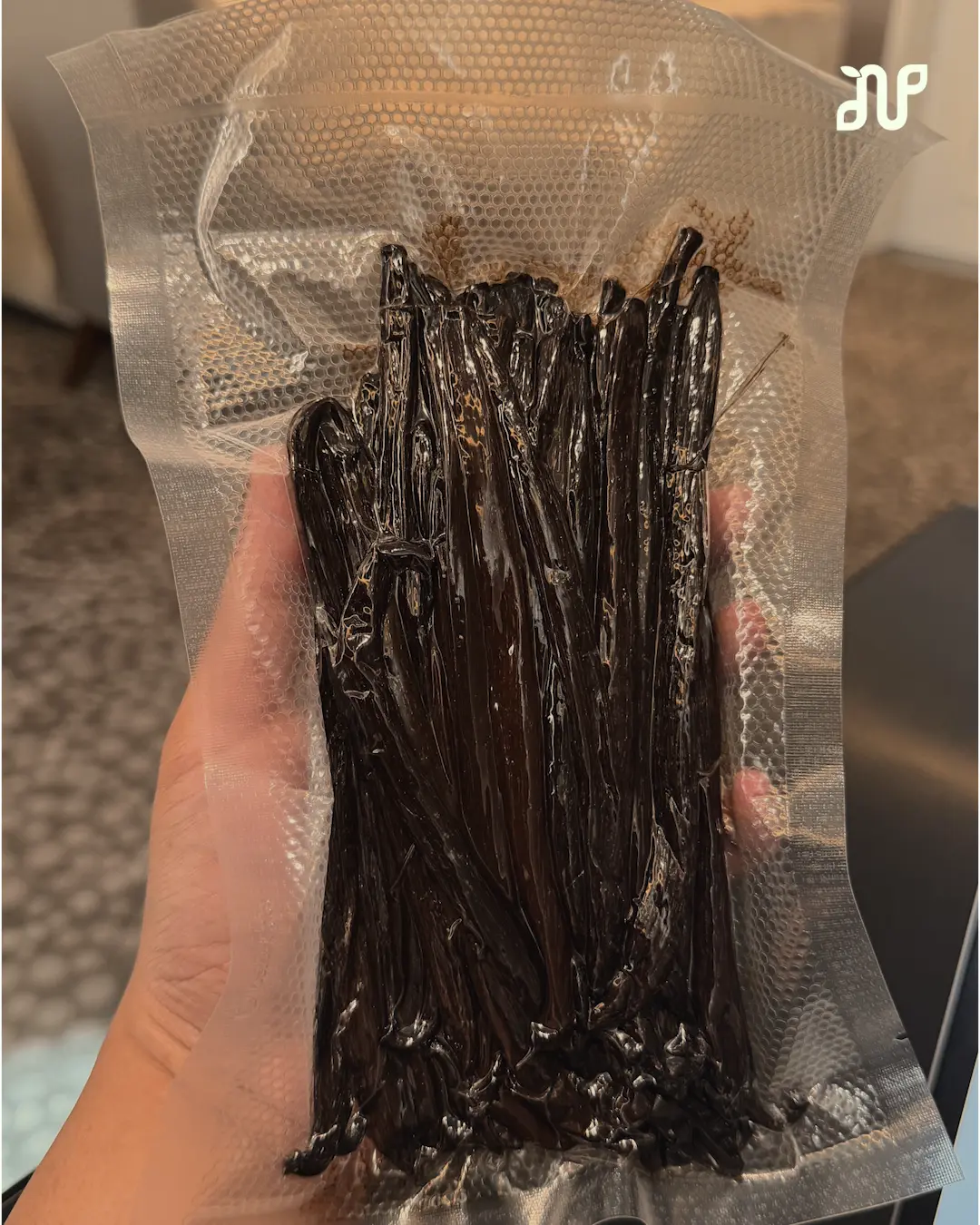
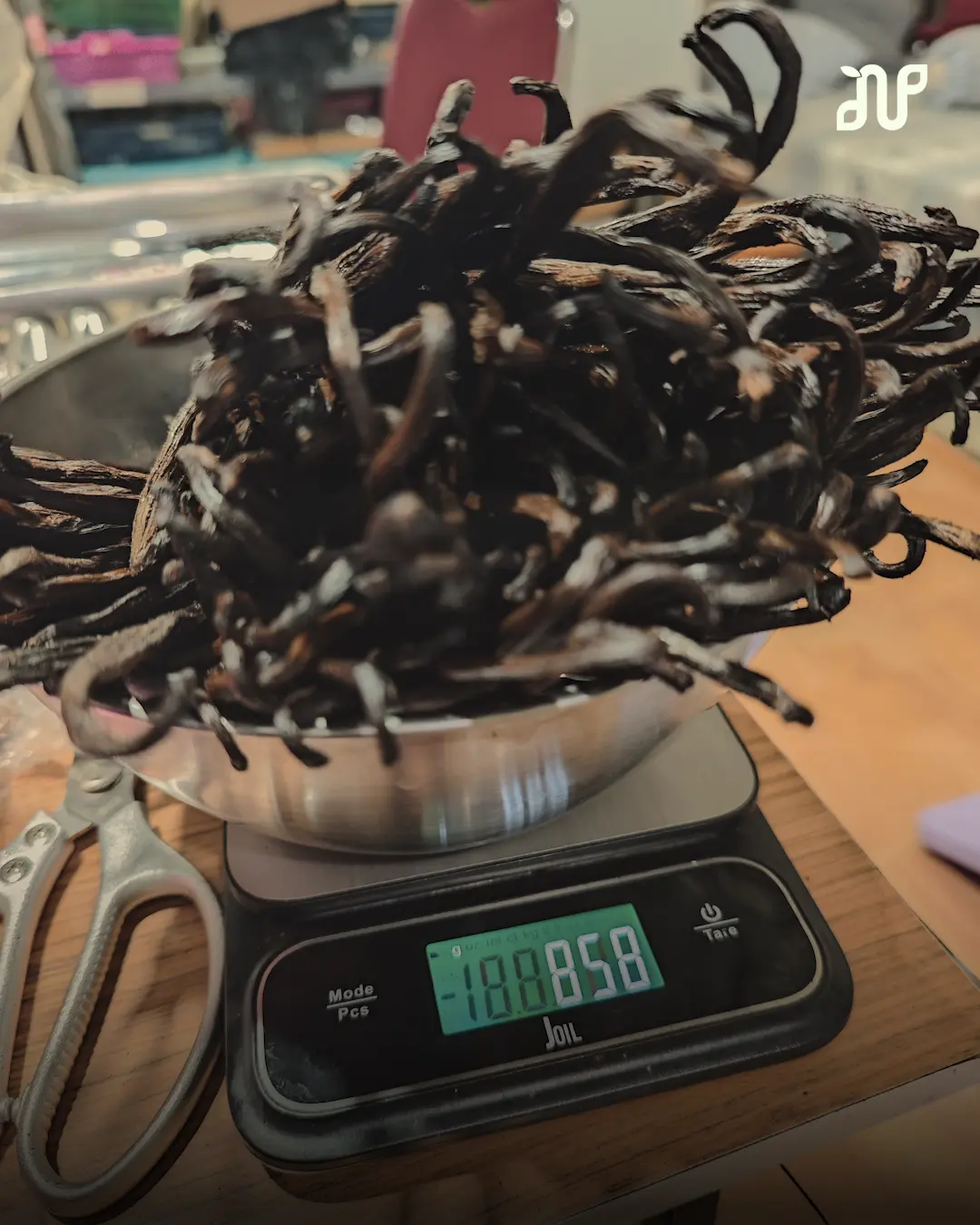
Pure vanilla worth it is a question that comes up every time someone picks up a Nalua bean, checks the price, and pauses. It is a fair question. Real vanilla is not cheap, and in a world where synthetic vanillin exists in almost every mass-market product, it is reasonable to ask what exactly you are paying for. The answer is not a short one, because the process behind a genuine vanilla bean is not a short one either. But by the end of this, the price will make sense.
Pure Vanilla Worth It Starts With the Flower
A Window That Lasts Half a Day
Every vanilla bean begins as a flower on a vanilla orchid vine. That flower opens once, for approximately half a day, and then closes for good. If it is not pollinated during that window, it drops from the vine and there is no second chance. At Nalua, Pak Wayan walks the vines every single morning during flowering season, reading each bloom individually to determine whether it is ready. Some mornings he pollinates dozens of flowers. Some mornings only a handful are open at the right stage. There is no way to rush this, and no way to recover a missed day.
No Machines, No Shortcuts
Vanilla’s natural pollinator is the Melipona bee, native to Mexico and absent from every other vanilla-growing region in the world, including Bali. Without that bee, pure vanilla worth producing requires every flower to be pollinated by hand, one at a time, using a thin bamboo splinter to lift the membrane separating the flower’s male and female parts and press them together. It is precise, physical, and entirely dependent on the skill and consistency of the person doing it. At Nalua, that person is Pak Wayan, and no part of his work can be automated or delegated to a machine.
A Full Year Before the Bean Reaches You
Months on the Vine
After successful hand-pollination, the flower wilts and a small green pod begins to develop in its place. That pod takes several months to mature on the vine before it is ready to harvest. During that time, Pak Wayan monitors each pod individually, checking for signs of disease, early drop, or uneven development. The harvest itself is not a single-day event. Beans are picked one by one, each at the moment Pak Wayan judges it to have reached the right level of maturity. Speed here would cost quality, so it is not an option.
The Curing Process
A freshly harvested vanilla bean has almost no detectable vanilla scent. The aroma that makes pure vanilla worth every dollar it costs develops during curing, a multi-week process involving careful sequences of heat exposure, sweating, and slow drying that activates the enzymatic reactions producing vanillin, the primary aromatic compound in real vanilla. Done correctly, the result is a dark, supple, intensely fragrant bean. Done incorrectly or rushed, the bean moulds, dries out, or fails to develop its full aromatic depth. There is no fast version of this process that produces the same result.
What You Are Not Paying For When You Choose Synthetic
Synthetic vanillin is cheap because it skips everything described above. It is produced industrially, in large volumes, from sources including lignin and petrochemicals. It smells like one thing: a simplified, linear approximation of vanilla. It works, in the sense that it registers as vanilla-adjacent to most palates. But it does not contain the hundreds of aromatic compounds present in a real, cured vanilla bean, and it does not behave the same way in cooking. It does not deepen when heated. It does not develop across a recipe. It delivers one note and stops there.
Real Vanilla in Your Kitchen
Pure vanilla worth using in a serious kitchen is not interchangeable with synthetic essence. Real vanilla changes a recipe in ways that go beyond flavour: it adds warmth, complexity, and a depth that synthetic versions approximate but never fully reach. Bakers who have cooked with both will tell you the difference is not subtle. It is the difference between a cake that tastes considered and one that simply tastes sweet.
Why Nalua Pure Vanilla Is Worth It
One Farm, One Farmer, Full Transparency
Nalua’s vanilla comes from a single agroforestry farm in Bali, grown by Pak Wayan within a multi-canopy system of vanilla vines and gliricidia shade trees. Founders Dio and Citra built the farm around a commitment to growing pure vanilla the way it deserves to be grown: without synthetic inputs, without shortcuts in the curing process, and with complete honesty about what goes into every bean. When you buy from Nalua, you are not buying from an anonymous supply chain. You are buying a bean with a specific origin, a specific farmer, and a growing process you can trace from the flower forward.
Limited by Nature, Not by Choice
Nalua cannot produce vanilla at unlimited scale, because the process does not allow for it. The farm produces what the flowering season makes possible, and the flowering season produces what Pak Wayan’s hands and the vines’ own timing allow together. That natural ceiling on supply is part of what makes pure vanilla worth protecting as a category. It is a product that exists because someone, somewhere, chose to do something slowly and carefully in a world that consistently rewards doing things fast.
If you have been wondering whether pure vanilla worth the price is a real thing or just a premium label on an ordinary product, Nalua exists to answer that question with the bean itself. Explore Nalua’s full range of pure vanilla products at vanillabali.com, or follow @naluavanillabali to watch the farm, the process, and the people behind every bean.